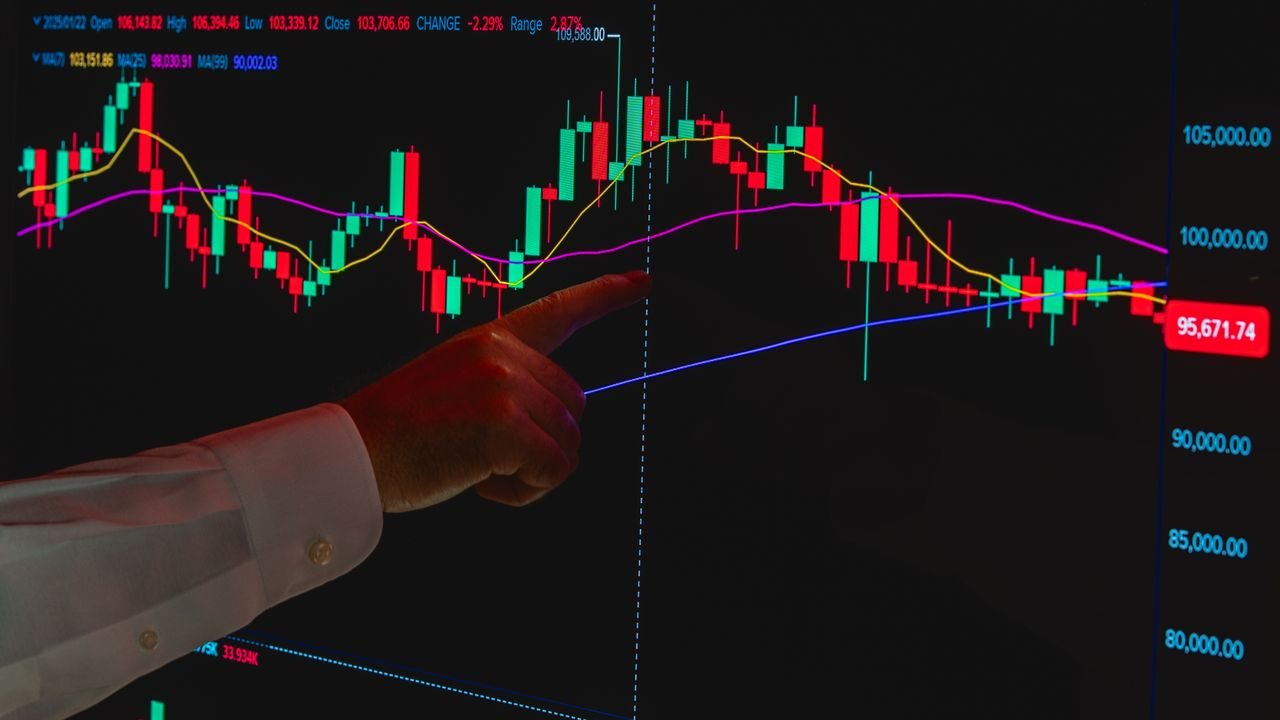

What moves crypto prices is mostly a handful of forces: global liquidity and risk appetite, regulation news, exchange events, stablecoin flows and where money sits within crypto itself. Thin weekend trading then magnifies whatever those forces start. Knowing which driver is in charge each week will not tell you where price goes, but it helps you judge how much to trust a chart.
Quick answer: what moves crypto prices?
Crypto prices are driven by global liquidity and risk appetite, regulation headlines, exchange hacks or failures, stablecoin flows that show money entering or leaving, bitcoin dominance that shows where it sits, and thin weekend liquidity that exaggerates moves. Leverage then turns ordinary moves into sharp swings as positions are forced closed.
Why crypto volatility is so high
Crypto trades 24 hours a day, seven days a week, with no closing auction and no central market. Order books are thinner than in major currencies, and a lot of trading uses leverage, so a modest wave of selling can trigger forced liquidations that push price further. That is the engine behind crypto volatility.
Before going further, the plain facts. Cryptoassets are high risk and largely unregulated in the UK for consumer protection, and you could lose all your money. We cover crypto as one market among several, never as a shortcut, and our older piece asking whether bitcoin is a bubble shows how long that debate has run.

Liquidity and risk appetite: the macro driver
When interest rates are falling and investors feel brave, money flows into riskier assets, and crypto has often been near the front of that queue. When rates rise or markets turn fearful, crypto tends to be sold early. In recent years bitcoin has often moved in step with technology stocks.
The US dollar is a big part of this backdrop. A strong dollar usually reflects tighter conditions, and our guide to what moves the US dollar explains the data and central bank meetings behind it. For how crypto links to other markets more broadly, see our intermarket analysis guide for beginners.
Regulation news, exchange events and hacks
Crypto market drivers include headlines that would barely move a stock index. A ban, a court ruling, an approval of a new investment product or a tax change can reprice a coin within minutes. Regulation news cuts both ways, so judge the reaction at your levels rather than the headline.

When an exchange fails
Exchange hacks and insolvencies hit the whole market because they damage trust and trap funds. The Bank for International Settlements found that after the Terra/Luna and FTX collapses in 2022, large investors sold while smaller retail investors bought, and that a majority of crypto app users in nearly all economies made losses on their bitcoin holdings. That is the reality behind the headlines.
How you hold crypto matters as much as how you trade it; our guide on how to safeguard your cryptocurrency covers the basics.
Stablecoin flows and bitcoin dominance
Stablecoins are tokens designed to track a currency, usually the US dollar, and they are the main way money moves around crypto exchanges. A rising total stablecoin supply suggests fresh money arriving; a shrinking supply suggests money leaving. It is a slow gauge, useful for the backdrop rather than timing.
Bitcoin dominance is bitcoin’s share of total crypto market value. When it rises, money is concentrating in bitcoin, often in cautious phases; when it falls, smaller coins are usually taking the lead. Our explainer on bitcoin dominance explained walks through how we read it.

Weekends and thin liquidity
At weekends banks are shut, traditional markets are closed and many professional desks step back. Fewer buyers and sellers means a single large order can move price further than it would on a Tuesday. Sharp weekend moves often get tested or reversed when liquidity returns on Monday.
Cycles and the bigger picture
Bitcoin has historically moved in long boom-and-bust cycles, often discussed alongside its four-yearly halving, when the reward for mining new coins is cut. Our guide to bitcoin market cycles explained covers how we think about them. Cycles describe the past and are not a timetable for the future.

The weekly drivers above sit inside that larger cycle, which is why the same headline can spark a rally in one year and be ignored in another.
| Driver | Why it moves price | What to check each week |
|---|---|---|
| Liquidity and risk appetite | Crypto is bought early in risk-on phases and sold early in risk-off | Central bank dates, US dollar, tech stocks |
| Regulation news | Changes who can buy, hold or list a coin | Scheduled rulings, consultations, deadlines |
| Exchange events and hacks | Trapped funds and lost trust trigger selling | Withdrawal halts, outages, major platform news |
| Stablecoin flows | Shows money arriving or leaving | Direction of total stablecoin supply |
| Bitcoin dominance | Shows whether money favours bitcoin or smaller coins | Weekly trend in dominance |
| Weekend liquidity | Thin order books exaggerate moves | Friday position size and stop distance |
| Leverage | Forced liquidations extend moves | Sharp spikes near obvious levels |
Your weekly crypto checklist
We run through this each weekend, before the new week opens, and it takes about fifteen minutes:
- Note the week’s central bank meetings and major US data.
- Check the trend in the US dollar and in technology stocks.
- Scan for scheduled regulation decisions or platform events.
- Look at the direction of stablecoin supply and bitcoin dominance.
- Mark your supply and demand zones on the weekly and daily charts.
- Decide your maximum risk and whether to hold anything over the weekend.

A worked example of sizing for crypto volatility
Example: on a £5,000 account you risk 0.5%, or £25, on a crypto trade. Because crypto swings are wide, your stop sits 8% below entry rather than the 1–2% you might use elsewhere. That means a position worth about £312 (£25 ÷ 0.08), far smaller than many beginners expect.
The wider the stop, the smaller the position, which is the whole point. Our guide on how to calculate position size shows the method step by step.
Common mistakes
- Trading every headline. Most news is noise; wait for price to react at your levels.
- Sizing crypto like forex. The same percentage stop means very different risk.
- Ignoring the weekend. Holding a full position into thin markets invites gaps against you.
- Chasing after a spike. Buying because price already jumped is fear of missing out, covered in our guide on how to stop emotional trading.
- Treating cycles as a forecast. Past patterns explain context, not next month’s price.
Frequently asked questions
Why is crypto so volatile?
It trades around the clock with thinner order books than major currencies, and much of the activity uses leverage. When positions are forced closed, moves extend quickly in either direction.
Why does crypto often move sharply at weekends?
Banks and traditional markets are closed and many professional traders step back. With fewer orders in the book, large trades move price further than usual.
Does bitcoin move the rest of the crypto market?
Usually, yes. Bitcoin is the largest cryptoasset, so big bitcoin moves tend to pull other coins with them, and dominance shows whether money is favouring bitcoin or smaller coins.
Can news predict what moves crypto prices next?
No. News explains why price is moving, but the same headline can produce opposite reactions depending on positioning and the wider cycle. Use it as context alongside your levels.
Next steps
For background on the market itself, read our earlier look at the crypto-asset market, then build the habit of deciding when not to trade and stay flat. If you want a structured path, the free basics section of our trading course starts with building a foundation.
This article is for education only and is not financial advice. Trading leveraged products such as CFDs and spread bets carries a high risk of losing money.