A weekly trading review is a fixed, short session where you look back at every trade from the week, judge it against your rules and pick one thing to improve. Done well, it takes around 30 minutes and turns a pile of results into a clear lesson. Below is the routine we use, a checklist you can copy and an example from our own desk.
Quick answer: how do you do a weekly trading review?
Set aside 30 minutes at the same time each week. 1) Export your trades, 2) tag each one by setup, 3) mark whether you followed your rules, 4) record the result in R, 5) log any mistakes, and 6) choose one change for next week. Judge decisions, not just profit and loss.
Why a weekly trading review matters
A single trade tells you almost nothing, because any setup can win or lose on its own. A week of trades starts to show patterns: which setups you take, when you break rules and how your losses compare with your wins. Daily reviews are useful for notes, but weekly is where we make decisions.
The review also protects you from your own memory. Research summarised by the CFA Institute lists hindsight bias, confirmation bias and overconfidence among the behavioural biases of individual investors, and notes that detecting them is the first step to overcoming them. A written record is how you catch them.
How to review your trades in six steps
This is the routine we teach. Keep the same order every week so the review becomes a habit rather than a chore.
- Export the week’s trades.
- Tag each trade by setup.
- Check rule adherence.
- Record every result in R.
- Update your mistakes log.
- Choose one change for next week.
1. Export your trades
Download the week’s history from your platform into a spreadsheet. You need the instrument, direction, entry, stop, exit and size for every trade. Add a chart screenshot taken at entry if you have one, because it shows what you saw before you knew the outcome.
2. Tag each setup
Give every trade a short label such as “supply zone rejection” or “breakout retest”. After a few weeks, tags show which setups carry your results and which quietly drain them. If your setups are not clearly defined yet, start with our guide to building a filters and triggers process.
3. Check rule adherence
Mark each trade “followed plan” or “broke plan”, and note which rule was broken. This is the most important column in the sheet. A rule-breaking winner is a warning, not a success, because it rewards a habit that will cost you later.
4. Record results in R
R is the amount you planned to risk on a trade. A trade that made twice its risk is +2R, and a full stop-out is -1R. Measuring in R lets you compare trades of different sizes and markets fairly, and it shows why win percentages alone tell you little.
5. Update your mistakes log
Write down each mistake in one plain sentence: moved stop, entered early, traded during news, oversized. Count how often each one appears. Most traders find two or three repeat offenders, and those usually connect to the patterns described in our guide on how to stop emotional trading.
6. Choose one change
Pick a single, specific change for next week, such as “no trades in the first 15 minutes after the London open”. One change is something you can test. Five changes at once is a new system, and you will not know which one helped.

Trade review checklist
Use this trade review checklist as your template. Each question links what you measure to what you might change.
| Review question | What to measure | What to change |
|---|---|---|
| Did I follow my rules? | % of trades marked “followed plan” | Target the most broken rule |
| Which setups worked? | Total R per setup tag | Pause setups that keep losing |
| Did I risk what I planned? | Planned R vs actual loss on stop-outs | Recheck position sizing |
| Did I cut losers and hold winners? | Average win in R vs average loss in R | Review exits and stop moves |
| Did I overtrade? | Number of trades vs your weekly norm | Set a daily trade limit |
| What did emotion cost me? | R lost on logged mistakes | One rule for the worst habit |
Worked example: a week in R
Example: on a £5,000 account, a trader risks 1% per trade, so 1R is £50. This is a hypothetical week, not a record of real trades.
The trader took eight trades. Five followed the plan and finished +2R, +1.5R, -1R, -1R and +2R, a total of +3.5R. Three broke the plan: one entered early and lost -1R, one moved the stop and lost -1.8R, and one doubled the size and won +2R.
The week finished +2.7R overall, which looks fine. The review tells a different story: the planned trades made +3.5R, while the rule breaks added risk and nearly wiped out the gains before a lucky oversized winner. The one change for next week is “never move a stop further away”, and the trader rechecks how much to risk per trade before Monday.
From the desk (April 2020)
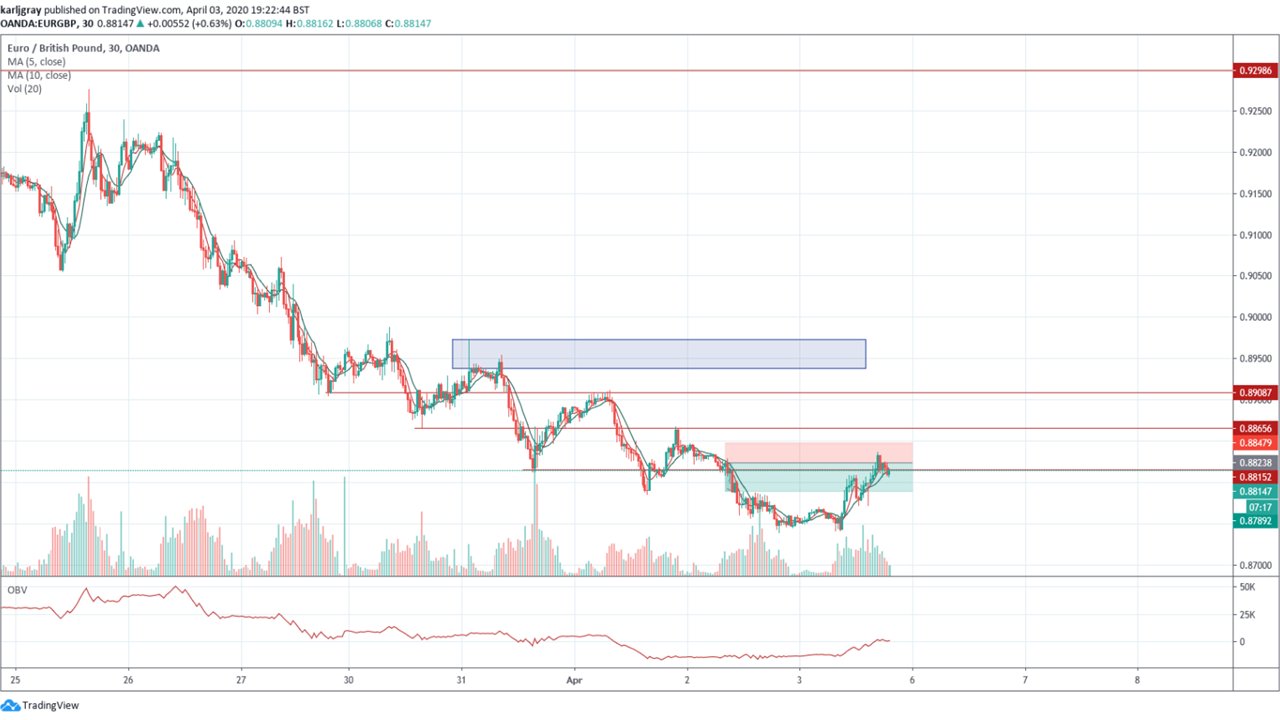
This page began as Karl’s short write-up of the first week of April 2020. It is kept below as a historical example of how we shared trade analysis, and past results are not a guide to future results. In his words:
A nice start to April, here is the analysis for a couple of the trades we took. New traders should especially pay attention to the EURGBP trade as the market was pretty much perfect!
If you have any questions regarding technical analysis please get in touch via our contact page.

Notes like these are the raw material for a weekly review. The point is not whether a week was good, but whether the trades that made it followed the plan. For another dated example from that period, see our GBPUSD price action strategy write-up.
Common mistakes in a trade review
- Judging by profit alone. A green week built on broken rules is a warning sign.
- Hindsight analysis. Marking up the chart after the move makes every trade look obvious. Review from the entry screenshot.
- Changing the system after one week. Eight trades is a tiny sample, so test one change for several weeks.
- Skipping the review after a bad week. That is the week you most need it.
- Reviewing without a plan to compare against. If your rules are not written down, start with a rules-based trading risk model.
Frequently asked questions
How long should a weekly trading review take?
For most part-time traders, 30 to 45 minutes is enough. Keep it at the same time each week, such as Friday after the close or Sunday afternoon. A short review done every week beats a long one done occasionally.
Should I review winning trades as well as losing ones?
Yes, every trade gets the same questions. Winning trades that broke your rules are some of the most important to catch, because the profit hides the habit. Losing trades that followed your rules are usually fine.
What is a good trade review checklist?
A good checklist asks whether you followed your rules, which setups worked, whether you risked what you planned and what emotion cost you. Measure each in R or as a percentage of trades. Then pick one change.
Is a daily or weekly review better?
Both have a place. A quick daily note captures how you felt and why you entered, while the weekly review has enough trades to spot patterns. We make changes to the plan only at the weekly review.
Next steps
Pair your review with our guide on how to prepare for the trading week ahead, and read our guide to the psychological hurdles traders face to understand the mistakes your log uncovers. If you want a structured path, the free basics section of our price action trading course covers rules, risk and psychology in order.
This article is for education only and is not financial advice. Trading leveraged products such as CFDs and spread bets carries a high risk of losing money.