How much to risk per trade comes down to one decision you make before every entry: the most you will lose if your stop is hit. For most traders that should be a fixed percentage of the account, usually between 0.5% and 2%. Below, we show why, what losing streaks do at each level and how to turn the percentage into a stake in pounds.
Quick answer: how much should you risk per trade?
Most traders are best served risking a fixed 0.5% to 2% of their account on each trade, with 1% a sensible default while learning. Risk means the amount you lose if your stop is hit, not the money you put up as margin. Small fixed percentages keep a long losing streak survivable.
Risk per trade is not the same as position size
Risk per trade is the loss you accept if the trade fails. Position size is how big the trade is. They are linked by the distance to your stop.
A beginner who says “I only put 2% of my account in” is usually describing margin, not risk. With leverage, a small deposit can control a large position, and the loss can be many times that deposit. Our guide to how margin and leverage work covers the mechanics and the risks in more depth.

Why a fixed percentage between 0.5% and 2%
Every method has losing runs, even a good one. Your risk per trade decides whether a bad month is an annoyance or the end of the account. A fixed percentage also shrinks your stake automatically as the account falls, which slows the damage.
The table shows the drawdown after a run of consecutive losses at each risk level, compounding on the current balance. The last column shows the gain needed to get back to where you started after 20 losses.
| Risk per trade | After 10 losses | After 20 losses | Gain needed to recover from 20 |
|---|---|---|---|
| 0.5% | -4.9% | -9.5% | +10.5% |
| 1% | -9.6% | -18.2% | +22.3% |
| 2% | -18.3% | -33.2% | +49.8% |
| 5% | -40.1% | -64.2% | +179% |
Twenty losses in a row sounds extreme, but over hundreds of trades long streaks do happen, and they usually arrive when you are least expecting them. At 1% you are bruised. At 5% you need to nearly triple what is left just to break even.
Where we sit
When people ask us how much to risk per trade, we treat 1% as the default for anyone still learning a method, and 0.5% while a new approach is being tested live. We would only consider going towards 2% with a long, written record of the method behaving as expected.

Adjusting for win rate and risk–reward
The right percentage depends on how your method actually wins. A low win rate with large winners produces longer losing runs than a high win rate with small winners. So the lower your win rate, the smaller your risk per trade should be.
Hypothetical example: a method that wins 40% of the time and makes 2R on its winners (twice the amount risked) averages +0.2R per trade over many trades. Over a few hundred trades it will very likely see six or more losses in a row, so it suits 0.5%–1%. Our post on why win percentages matter less than risk and reward explains why a 40% win rate is not a problem in itself.

Fixed percentage vs fixed £ amount
Some beginners prefer to risk the same number of pounds on every trade because it is easier to picture. It works while the account is roughly where it started, but it behaves badly in a drawdown.
| Factor | Fixed % per trade | Fixed £ per trade |
|---|---|---|
| Adapts to drawdowns | Yes: risk shrinks as the account falls | No: risk grows as a share of a smaller account |
| Grows with the account | Yes, automatically | Only if you change it |
| Easy to calculate | Needs a quick sum each trade | Very easy |
| Main danger | Tiny stakes on very small accounts | Quietly over-risking after losses |
Example: on a £5,000 account, £50 is 1%. After a rough patch takes the account to £4,000, that same £50 is 1.25%. The fixed £ approach has raised your risk at exactly the wrong time.
Turning the percentage into a spread-bet stake
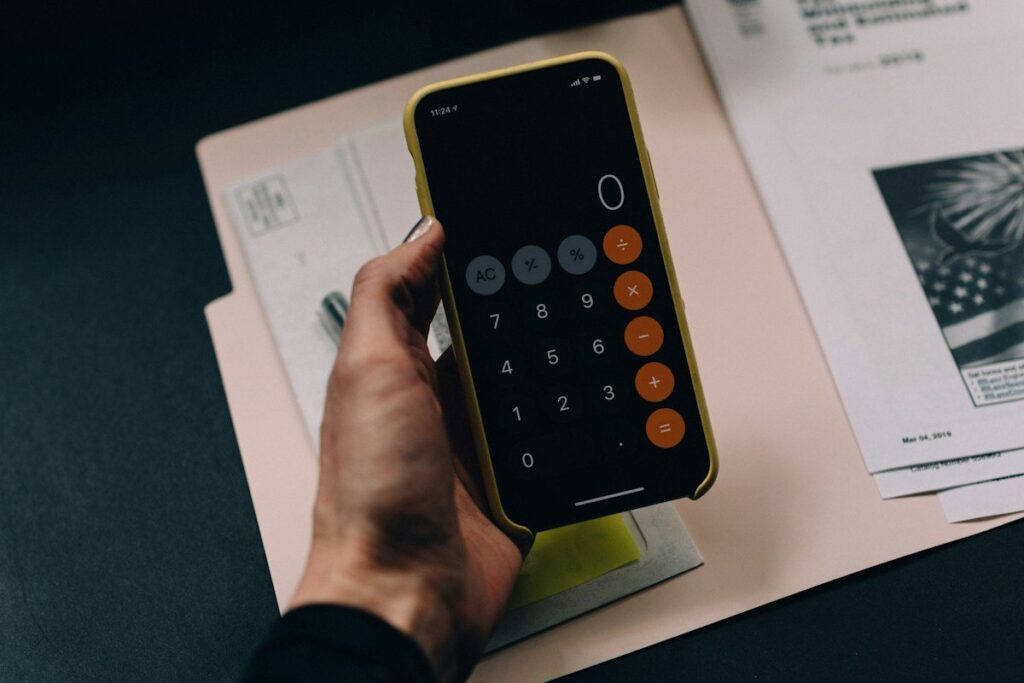
Spread bets are sized in pounds per point, so the sum is simple. Take the pounds you are willing to lose and divide by the stop distance in points.
- Work out your risk in pounds: account balance × risk percentage.
- Measure the stop distance in points from your entry to the level where the idea is wrong.
- Divide: £ risk ÷ stop points = £ per point.
- Round down, never up, to the nearest stake your provider allows.
Example: on a £5,000 account at 1%, the risk is £50. A 25-point stop gives £2 per point; a 50-point stop gives £1 per point. The wider stop does not mean more risk, just a smaller stake. There is a short archive note on calculating position size too, and our article on the importance of a stop loss covers why the stop comes first.
Spread bets and CFDs are leveraged, and markets can gap straight through a stop, so a real loss can exceed the planned one. The FCA limits the leverage firms can offer retail CFD clients to between 30:1 and 2:1 and requires a standard warning showing how many retail accounts lose money. Those limits still allow losses to build quickly.
Small accounts: the honest version
Example: on a £1,000 account, 1% is £10. With a 20-point stop that is £0.50 per point, and some markets will not accept a stake that small.
When your provider’s minimum stake is bigger than your rules allow, the answer is to skip the trade or choose a market with smaller minimums. Raising your risk to fit the trade is how small accounts become empty accounts. A small account is for learning the process; the pounds come later, if at all.

Common mistakes with risk per trade
- Confusing margin with risk. The deposit is not the loss; the stop distance decides that.
- Risking more when confident. Confidence is not information the market shares.
- Raising risk to win back losses. This is how a normal drawdown becomes a blow-up.
- Ignoring total open risk. Three correlated trades at 1% each can act like one 3% trade. We cap open risk at a few percent in total.
- Moving the stop instead of reducing the stake. If the stop needs to be wider, the stake gets smaller.
Most of these are emotional rather than mathematical, which is why our pillar on the psychological hurdles traders face sits alongside this one.
Frequently asked questions
Is 2% risk per trade too much?
Not automatically, but it is the top of the sensible range. Twenty straight losses at 2% leave you down about a third, needing roughly 50% to recover. We would only use it with a proven, written method.
How much should a beginner risk per trade?
We suggest 1% or less while learning, and 0.5% while testing anything new. The aim at this stage is to survive long enough to learn, not to grow the account quickly.
Should I risk more on trades I feel sure about?
We keep risk fixed. Varying it by feel lets emotion back into the one part of trading you can fully control, and losing streaks often begin with the trades that looked best.
Does the stop size change how much I risk?
No, it changes the stake. The pounds at risk stay fixed and the stake adjusts, so a wider stop means a smaller stake per point.
Next steps
Deciding how much to risk per trade is one rule in a wider risk model. Our pillar on building a rules-based trading risk model covers the rest, and our guide to spotting the start of a new trend shows where early and confirmed stops sit.
Building a rules-based risk model is part of our price action trading course, and the basics section is free.
This article is for education only and is not financial advice. Trading leveraged products such as CFDs and spread bets carries a high risk of losing money.