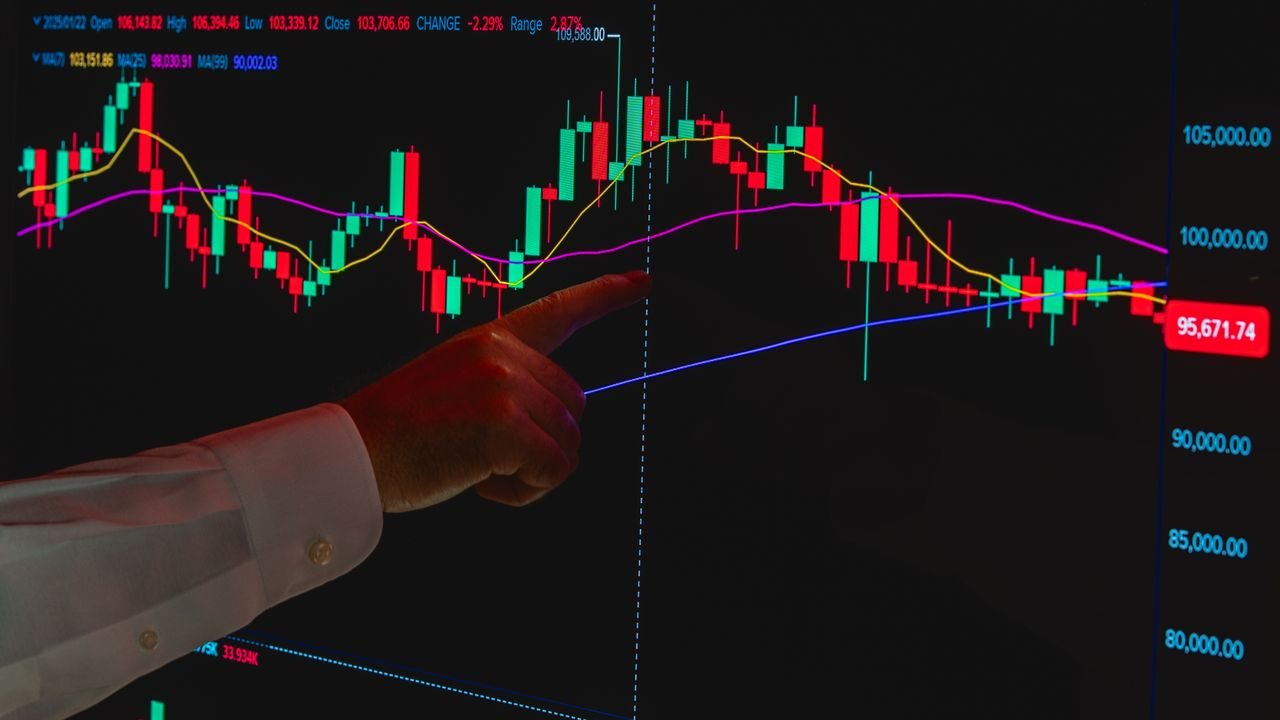

Learning how to trade during a market crash is mostly about defence: cut your position size, give trades more room with smaller stakes, respect wider spreads and gaps, and accept that sitting out is a valid choice. March 2020 showed every one of these lessons at once. This page sets out what happened that month and the rules we take from it.
Quick answer: how do you trade during a market crash?
Trade smaller than usual, because daily ranges can be several times normal. If you widen your stop, cut your stake so the money at risk stays the same. Expect wider spreads and price gaps through your stop. Wait for structure before buying, and remember that not trading at all is often the best decision.
What happened in the March 2020 crash
The March 2020 crash came as the Covid-19 pandemic spread and governments moved towards lockdowns. Indices, oil and currencies moved further in a day than in a normal week. In the US, stock markets triggered their market-wide circuit breakers more than once that month, pausing all trading after sharp falls in the S&P 500.
Central banks acted quickly. The Bank of England cut Bank Rate by 50 basis points to 0.25%, announced on 11 March 2020. On 19 March, at a special meeting, it cut again to 0.1% and added £200 billion of asset purchases, noting that conditions in the UK gilt market had deteriorated.
From the desk (19 March 2020)
Karl first published a market breakdown on this page on 19 March 2020, the day of that second rate cut. The original write-up was not preserved in any archive, so we cannot reproduce his levels or views. This page has been rebuilt as a lesson-led guide instead, and it adds no trades or results to his name.

What changes when markets crash
A crash is not just a big down move. Several things you take for granted stop working, and each one affects your risk.
Ranges expand
Trading high volatility means candles that are two, three or more times their usual size. That is why a fixed-distance stop and a fixed stake are a dangerous pair in a crash.
Liquidity thins and spreads widen
When everyone wants to sell at once, fewer participants are willing to buy. Providers widen spreads to reflect this, often sharply around the open. A wider spread means you start each trade further behind, and stops can be triggered by the spread alone.
Gaps jump through stops
Prices can open well away from the previous close, especially after a weekend or an overnight announcement. A standard stop loss is an instruction to close at the next available price, not at your chosen level. Read our guide to where to place a stop loss and why it matters before you rely on one in a fast market.

How to trade during a market crash: six rules
These are the rules we apply when volatility explodes. None of them tries to predict the bottom.
- Cut your size first. Drop your usual risk per trade, for example from 1% of the account to 0.5%, until ranges settle.
- Wider stops mean smaller stakes. If the chart needs a stop three times further away, your stake must be roughly a third.
- Check the spread before every entry. If the spread is a large share of your stop distance, the trade is not worth taking.
- Plan for gaps. Reduce or close positions before weekends and scheduled announcements if a gap would hurt more than you can accept.
- Do not catch falling knives. Wait for price to build a higher low and break a recent swing high before buying.
- Sitting out is a position. If you cannot define your risk, do not trade.
Rules one and two are the heart of a rules-based risk management model. If you are unsure what a sensible starting figure is, our guide on how much to risk per trade walks through the options.
Leverage cuts both ways
CFDs and spread bets let you control a large position with a small deposit. In a crash, that leverage magnifies losses just as fast as gains, and margin calls can close positions at the worst moment. If margin and leverage are new to you, learn them before you trade a volatile market.
Crash conditions at a glance
The table pairs each crash condition with the mistake it tends to cause and the habit we use instead.
| Crash condition | What goes wrong | What to do instead |
|---|---|---|
| Ranges two to three times normal | Normal stops hit by noise | Wider stop, smaller stake |
| Wide spreads | Trades start deep in the red | Skip trades where spread is large versus stop |
| Weekend and news gaps | Stops fill far beyond the level | Cut exposure before known gaps |
| Steep one-way falls | Buying every dip too early | Wait for a higher low and a break |
| Margin pressure | Forced closes at the lows | Lower leverage, more free margin |
| Fear and headlines | Panic trades and revenge trades | Fewer trades, or none |
Worked example: same risk, wider stop
Example: on a £5,000 account, a trader normally risks 1%, which is £50, on an index trade with a 40-point stop. That works out at £1.25 per point. This is a hypothetical illustration, not a trade from our desk.
Now the index is moving three times its usual range, so the chart needs a 120-point stop. Keeping £1.25 per point would put £150 at risk, three times the plan. Instead, the trader divides £50 by 120 points and stakes about £0.40 per point, which risks £48.
In a crash we would go further and halve the risk to 0.5%, so £25 divided by 120 points gives roughly £0.20 per point. Our full guide to calculating position size step by step shows the same sum for forex and commodities.

Common mistakes in a crash
In our experience, most crash damage comes from a few repeated errors rather than from bad analysis.
- Keeping normal size. The stake looks the same, but the risk is several times larger.
- Moving the stop instead of closing. Hoping for a bounce turns a planned loss into a large one. Our tip on why traders should cut losses early applies doubly here.
- Buying the first big red candle. A falling market can keep falling for days.
- Trading the headlines. Fear and urgency lead to emotional trading decisions you would never make on a calm day.
- Forgetting that doing nothing is allowed. Knowing when not to trade at all protects capital for clearer conditions.

Frequently asked questions
Should you buy the dip in a market crash?
Buying a falling market without structure is guessing. We prefer to wait for price to stop making lower lows, form a higher low and break a recent swing high.
Why did my stop loss fill at a worse price?
A normal stop becomes a market order once price reaches it, so it fills at the next available price. In a gap or a fast market that price can be well beyond your level. Some providers offer protected stops that cap this, usually for a fee.
Is it better to short or stay out during a crash?
Short selling is just another trade, with the same rules on size, spreads and gaps. Sharp short-covering rallies are common in crashes and can hit tight stops. If you cannot define your risk clearly, staying out is the better choice.
How much should I risk per trade when volatility is high?
Many traders halve their normal risk until ranges calm down. The exact figure matters less than keeping the money at risk fixed while stops get wider. That means reducing your stake per point as the stop distance grows.
Next steps
Start with our trading risk management pillar guide, then read how to judge whether a trade is worth the risk before your next volatile session. When you are ready for a structured route, the free basics section of our price action trading course covers risk, when not to trade and the psychology that crashes test hardest.
This article is for education only and is not financial advice. Trading leveraged products such as CFDs and spread bets carries a high risk of losing money.