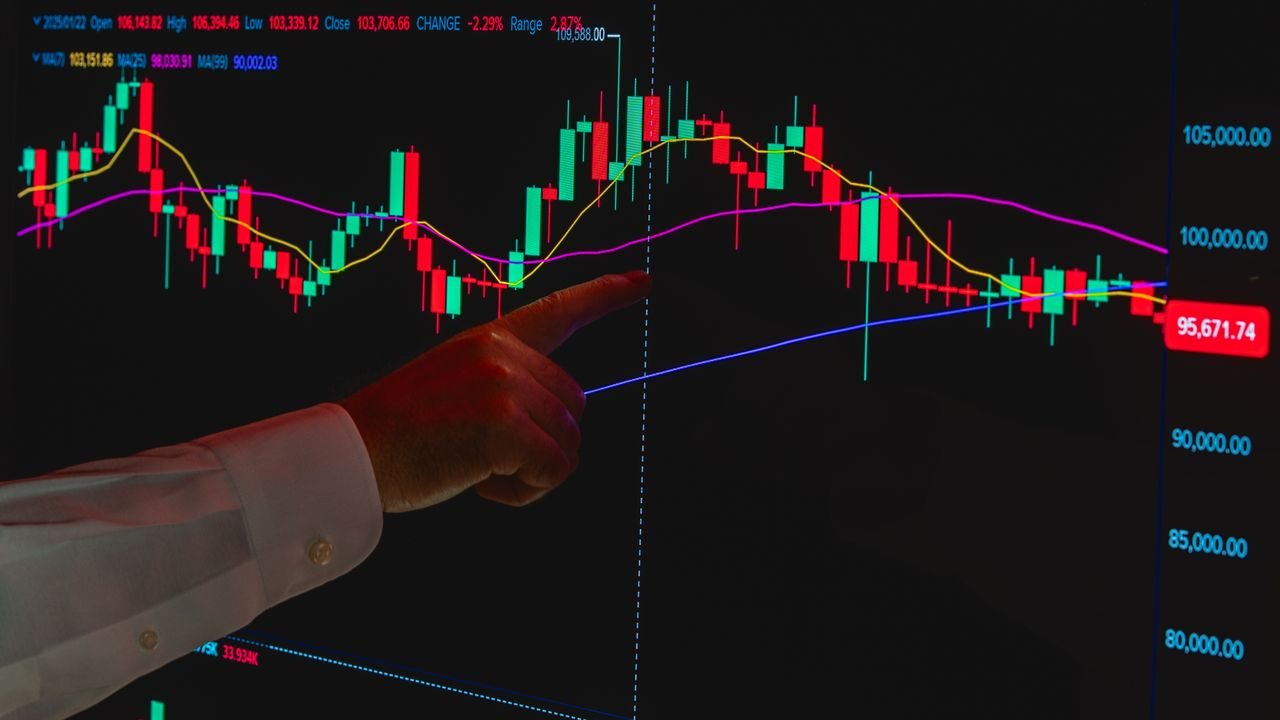

Diversifying a trading portfolio means making sure your open trades do not all depend on the same market move. For an active trader, that is less about owning many assets and more about correlation: whether your positions tend to rise and fall together. Five trades that all win or lose on one piece of US dollar news are really one large trade.
Quick answer: how do you diversify a trading portfolio?
Check how your open trades are correlated, group trades that share a currency or theme, and cap the total risk on each group. Spread exposure across asset classes such as forex, indices, metals and commodities, but remember correlations change, and in a sharp sell-off many markets can fall together.
What correlation means in trading
Correlation measures how closely two markets move together. A positive correlation means they usually move in the same direction; a negative correlation means they usually move in opposite directions. Uncorrelated assets show no consistent relationship.
The idea is old and simple. The U.S. Securities and Exchange Commission’s beginners’ guide to asset allocation and diversification explains it with a street vendor who sells both umbrellas and sunglasses, and says diversification should happen both between and within asset categories. It also frames diversification as a way to limit losses and smooth returns, not to remove risk.
For traders, correlation in trading is measured on returns over a chosen period, usually as a coefficient between -1 and +1. Treat any reading as a snapshot. It changes with the timeframe you measure and with the market regime.

Hidden concentration: when several trades are really one
The most common problem we see is not too few markets but too many trades on the same idea. Every forex pair is two currencies, so going long EUR/USD, long GBP/USD and short USD/JPY is three ways of selling the US dollar. If the dollar strengthens, all three can lose at once.
Hidden concentration also hides in themes rather than currencies. Long positions in a stock index, the Australian dollar and copper can all be bets on improving global growth and appetite for risk. If you are unsure how each side of a pair works, our guide to trading forex in both directions explains base and quote currencies.
- Shared currency: several pairs with USD, EUR or JPY on the same side.
- Shared theme: risk-on positions across indices, commodity currencies and crypto.
- Offsetting trades: long EUR/USD and long USD/CHF often cancel each other out while you still pay costs on both.

How the asset classes we trade tend to group
Our desk covers forex, indices, precious metals, commodities and crypto. Uncorrelated assets trading is about combining markets driven by different forces, but each class has typical links worth knowing.
Many cross-market links come from one switch in mood. In “risk-on” periods traders buy growth-sensitive markets; in “risk-off” periods they retreat to assets often treated as safe havens, such as the US dollar, the Japanese yen or gold.
Forex
Pairs sharing a currency are often correlated. AUD/USD and NZD/USD, for example, tend to move together, so holding both is close to doubling one position. Our guide to correlation in forex trading shows how to net those positions by currency.
Indices
Major stock indices often move together, especially in sharp sell-offs. A long position in two large US indices is rarely diversification.

Metals and commodities
Gold is priced in dollars, so it often reacts to dollar strength or weakness. Oil and industrial metals tend to respond to growth expectations, and our article on metals, crypto and GBP critical levels shows the desk comparing these markets side by side.
Crypto
Crypto is sometimes described as uncorrelated, but in some periods it has moved with risk appetite in equities. Read our look at the crypto-asset market before treating it as a hedge.
Correlated vs uncorrelated exposure
| Combination | Usual relationship | What it means |
|---|---|---|
| Long EUR/USD + long GBP/USD | Often strongly positive | One short-USD bet, roughly doubled |
| Long AUD/USD + long NZD/USD | Often strongly positive | Near-duplicate positions |
| Long EUR/USD + long USD/CHF | Often strongly negative | Trades largely cancel out |
| Long stock index + long second index | Usually positive | Same equity risk twice |
| Long index + short EUR/GBP | Usually weaker | Different drivers, more genuine spread |
These relationships are tendencies, not rules. Check a current correlation reading on the timeframe you trade before relying on any of them.

How to cap correlated risk in a trading portfolio
Diversifying a trading portfolio works best as a written rule, not a feeling. We cap risk per trade and also cap risk per correlated group, so a single event cannot hit the whole account. It sits inside a wider rules-based trading risk management model.
- Set your maximum risk per trade as a fixed percentage.
- List open and planned trades, and label each by currency and theme.
- Set a cap for each group, for example twice your single-trade risk.
- If a new trade would breach a group cap, skip it or reduce size on the group.
- Set an overall cap on total open risk across every position.
Example: on a £5,000 account risking 1% per trade, each trade risks £50. With a cap of 2% per group, you could hold £100 of short-USD risk in total. Four short-USD trades at full size would put £200 on one idea, so you would take the best two or halve the size of each.
Work out the size of each position with our guide to calculating position size from your stop loss. Spread bets and CFDs are leveraged, so correlated losses can add up faster than you expect; understand how margin and leverage work before running several trades at once.

Common mistakes
- Counting trades, not exposures. Five positions can still be one bet.
- Assuming correlations are fixed. Relationships shift, and in stressed markets many assets fall together.
- Hedging by accident. Opposing correlated trades mostly cancel out while costs still apply.
- Adding markets you do not understand. Spreading into unfamiliar products for the sake of it adds risk, not safety.
- Raising size after a loss. Stacking correlated trades to win it back is a form of emotional trading.
Frequently asked questions
What is correlation in trading?
Correlation measures how closely two markets move together, usually from -1 to +1. Positive means they tend to move the same way, negative means they tend to move in opposite directions. It changes over time and by timeframe.
Is trading EUR/USD and GBP/USD at the same time doubling my risk?
Often, yes, because both pairs share the US dollar and frequently move together. If you hold both in the same direction, treat them as one larger position and cap the combined risk.
Does diversification stop you losing money?
No. It can reduce the size of losses and smooth results, but it does not remove risk. In sharp sell-offs, markets that usually move independently can fall at the same time.
Should a small account diversify?
A small account cannot spread across many markets at a sensible size. It is usually better to hold fewer trades with different drivers and keep total open risk capped. Two unrelated trades at full size are easier to manage than six overlapping ones at a fraction of it.
Next steps
Read the risk management pillar for the full model, then the risk per trade guide to set your base number. When you want a structured path, the free basics section of our trading course covers building a rules-based risk model step by step.
This article is for education only and is not financial advice. Trading leveraged products such as CFDs and spread bets carries a high risk of losing money.