
Is learning to trade worth it? For many people, yes, as long as they treat it as a skill that takes time and costs money to build, not as a shortcut to income. The value is in flexible hours, a skill you control and a clear view of risk; the price is study time and some losses while you learn.
Quick answer: is learning to trade worth it?
It can be, if you start part-time, learn on a demo account first and only risk money you can afford to lose. Trading offers flexibility and a skill that rewards effort, but most beginners lose money at first, and leveraged products make losses build quickly. Judge it by what you learn, not by early profits.
Is learning to trade worth it? The short, honest answer
The benefits are real: you choose your hours, you can learn alongside a job, and the skill is yours. The costs are real too. You will spend months studying, and the first live trades are usually the expensive part.
The regulator is blunt about the risk. When the FCA made its permanent restrictions on CFDs for retail consumers in 2019, it pointed to high proportions of consumers losing money. It capped leverage at between 30:1 and 2:1 and made firms show the share of their clients’ accounts that lose money.
| Area | What you gain | What it costs |
|---|---|---|
| Time | Flexible hours, part-time possible | Months of study and review |
| Money | A skill you can keep using | Course fees and early losses |
| Control | Results depend on your own work | No one to blame for mistakes |
| Location | Trade wherever you have internet | Markets keep their own hours |

Karl’s 5 reasons why learning to trade is worth it (December 2017)
Karl wrote this post on 22 December 2017. We have kept his surviving words below and removed lines that read as promises of returns. He began with how he got started:
I first got involved in trading during the summer of 2013. I was convinced I didn’t want to spend the rest of my life in an office working for someone else’s dream, but hadn’t yet figured out how I’d make my own way. Throughout most of my teenage years I was an avid poker player, but realised I didn’t have the patience to spend long hours alone playing online tables to build up a bank roll.
This is when I first got introduced to trading by a chance ad online – it changed my life so significantly that I moved from a path in Chemical Engineering to landing one of the most prestigious jobs in investment banking, to starting my own trading business – all by the age of 23.
It was immediately clear that trading opened a whole world I didn’t know was possible.
1. Get your time back
If there’s any reason to start trading, it’s the flexibility that it gives you. I repeat over and over that I only trade 15 minutes per day . If you want to trade more, you can. But why would you?
2. Work from anywhere
As long as you have access to an internet connection, you can trade. How many other jobs give you that much flexibility? I love nothing more than travelling to new places, and I have traded from nearly everywhere I’ve been in the last few years.
From the US mid-west to the Himalayas, a hostel in India to a resort in the Maldives. I have always found a way to check the markets and place my trades.

3. You get rewarded directly for your efforts
The most frustrating aspect about a 9-5 is that even at your most productive, your life is still controlled by your superiors and the organisation. Have you ever found yourself working twice as hard as someone else, but still getting the same pay-check? The market is the ultimate unbiased employer; it doesn’t care if you’re black or white, a man or woman, the only thing that matters is your determination .
4. Go full or part-time
Some people would prefer the security of a full-time job, and they are happy in what they do day-to-day. That’s fine. Trading isn’t an either/or scenario.
In my first years of trading I was studying, then I worked in the Oil and Gas industry, then I completed a Masters. By trading just 15 minutes a day I have been able to trade alongside other activities . You can too.
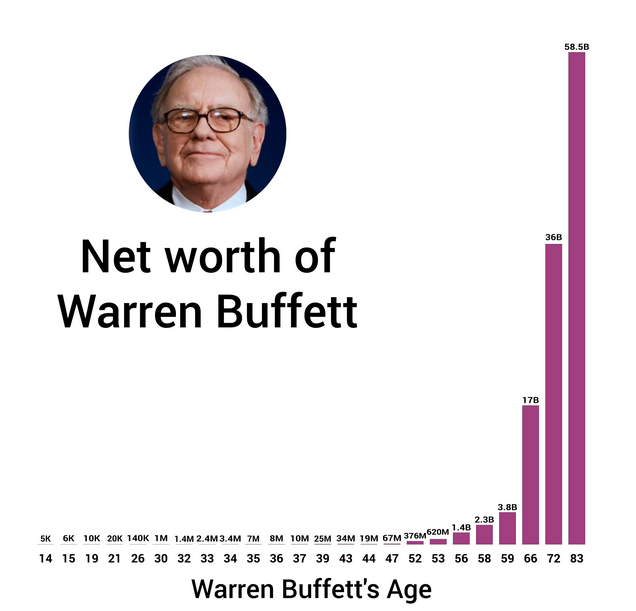
5. Near-unlimited potential
Karl’s fifth reason was compounding, and he illustrated it with the chart of how Warren Buffett’s wealth has grown over time, which we keep below. We have dropped the return figures he quoted: Buffett is a long-term investor with an exceptional record, not a benchmark for a beginner.
What we would add to each reason in 2026
Karl’s reasons still hold, but each one comes with a condition that beginners tend to miss.
- Time: 15 minutes a day works on higher timeframes such as the daily chart,. Intraday styles need far more screen time; our guide to scalping, day, swing and position trading styles compares them.
- Location: markets keep their own hours and connections fail, so use stop orders to protect a position while you are away.
- Effort: the market rewards effort directly, and it punishes mistakes just as directly. The habits that matter are covered in our post on the traits that make winning traders.
- Part-time: this is the best way to start. Keeping your income means you never need a trade to work, which removes much of the pressure.
- Potential: skill compounds more reliably than money. Leverage on CFDs and spread bets magnifies losses as well as gains, so read how margin and leverage work before you use them.

Worked example: what learning to trade might cost
Example: a hypothetical beginner in the UK plans a first year of learning. The figures are illustrations, not a forecast.
- Months 1 to 3: free material and a demo account. Cost: £0 in money, perhaps 4 to 5 hours a week of study.
- Months 4 to 6: practise a written plan on demo. The demo balance is reset to the amount they will really deposit.
- Months 7 to 12: a small live account of £1,000. They risk 1% per trade, which is £10.
If that trader has a run of 10 losing trades in a row, they lose about £96, because each loss is 1% of a slightly smaller balance. That is survivable, and it buys real experience.
Now imagine the same trader risking 10% per trade. The same 10 losses would take the account to about £349, a loss of roughly £651. The method is identical; only the sizing changed. Our guide on how much to risk per trade explains why small, fixed risk matters most while you learn.

Who learning to trade is worth it for (and who it is not)
In our experience, it tends to be worth it for people who:
- enjoy studying and reviewing their own decisions;
- can set aside a few hours a week for at least several months;
- have savings beyond the money they would trade with;
- see the first year as tuition rather than income.
It is usually not worth it, at least not yet, for anyone who needs the money for bills, wants a quick second income, or hopes a course will hand them a secret. If you are comparing courses, our checklist on how to choose a trading course and spot a scam helps you ask the right questions.

Common mistakes when starting to learn
- Going live too soon. Learn the platform and your method on demo first; see when to move from demo to live trading.
- Quitting a job to trade. Part-time learning keeps the pressure off.
- Skipping the basics. Our tip on what to learn before you start trading sets out the order.
Frequently asked questions
Is learning to trade worth it in the UK?
It can be, if you learn part-time and only trade money you can afford to lose. CFDs and spread bets are leveraged, so a small account can lose money quickly; a demo account lets you test whether trading suits you first.
How long does it take to learn trading?
Most people need many months of study and practice before they trade a plan consistently. Our guide on how long it takes to learn trading breaks the stages down.
Can you learn to trade alongside a full-time job?
Yes. Higher timeframes such as the daily chart let you analyse in the evening and set orders with stops, so you do not need to watch screens during work.
Next steps
Learning is easier with others: our article on why traders learn better together in a community explains how. When you are ready for structure, the basics section of our price action trading course is free to start.
This article is for education only and is not financial advice. Trading leveraged products such as CFDs and spread bets carries a high risk of losing money.